

When selecting sealing materials for gas piping systems, choosing the right thread sealant is essential for safety, leak prevention, and long-term reliability. Yellow Teflon tape for gas line applications is specifically designed for sealing compatible threaded pipe connections in gas systems. However, not all PTFE tapes are suitable for gas service, and buyers need to understand the differences between general-purpose thread tape and products approved for gas applications.
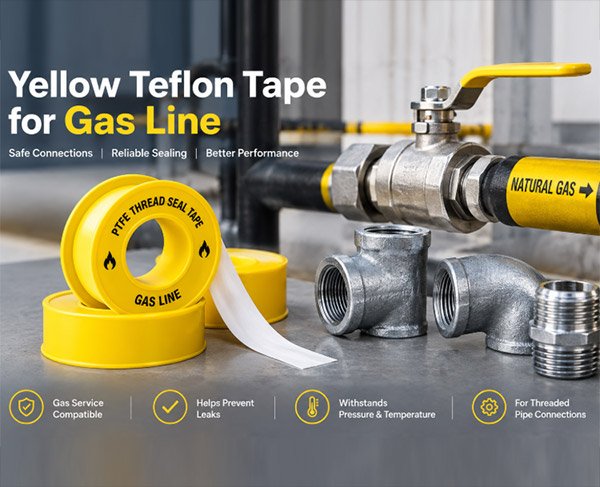
For distributors, plumbing contractors, HVAC installers, and industrial procurement teams, the key is to select a sealing product that matches the gas type, pipe material, thread standard, operating conditions, and applicable local regulations.
This guide explains what yellow gas-rated PTFE tape is, why ordinary white PTFE tape may be unsuitable for certain gas installations, how to select the right product, and what procurement teams should check before placing an order.
1. What Is Yellow Teflon Tape for Gas Lines?
Yellow Teflon tape is a PTFE (polytetrafluoroethylene) thread-sealing tape commonly manufactured for use on compatible threaded gas piping connections. It is typically yellow to distinguish it from white general-purpose PTFE tape used in many plumbing applications.
PTFE has useful properties for thread sealing, including chemical resistance, low friction, and the ability to conform to threaded surfaces during assembly. A properly specified PTFE tape can help create a gas-tight threaded joint when used with compatible fittings and installed according to the manufacturer’s instructions.
Yellow tape is commonly marketed for applications involving natural gas, propane, and other specified fuel gases. However, the yellow color alone does not prove that a product is certified, approved, or suitable for every gas system.
Before purchasing, buyers should verify the manufacturer’s technical documentation and applicable approvals for the intended application.
Yellow PTFE Tape vs. White PTFE Tape
| Feature | Yellow PTFE Tape | White PTFE Tape |
|---|---|---|
| Typical application | Gas-service threaded connections, subject to product approval | General plumbing and compatible threaded connections |
| Typical identification | Yellow | White |
| Formulation | Depends on manufacturer and product specification | Depends on manufacturer and product specification |
| Gas compatibility | Must be confirmed from product documentation | Must not be assumed without explicit approval |
| Purchasing priority | Gas-service suitability and compliance | Compatibility with the intended non-gas application |
The primary difference is not simply the color. The product specification, intended service, applicable standards, and manufacturer approval determine whether a particular tape is suitable for a gas installation.
2. Why Is Ordinary Teflon Tape Sometimes Not Recommended for Gas Lines?
The question “Why no Teflon tape on gas lines?” often arises because installers and buyers encounter different requirements across plumbing codes, gas system designs, and product specifications.
The important distinction is between using an unsuitable general-purpose tape and using a thread sealant specifically approved for the intended gas service.
2.1 Local Codes May Restrict the Use of Unapproved Tape
Gas installations are subject to safety codes and regulations that vary by country, region, building type, and application. Some jurisdictions specify acceptable thread sealants or require products to meet particular standards.
A tape that works well on a domestic water connection is not automatically acceptable for a natural gas or propane system.
For procurement teams, the practical approach is to confirm:
- The applicable gas installation code.
- Any required product certifications or listings.
- Whether the tape is approved for natural gas, propane, or the specified fuel gas.
- The pipe and fitting manufacturer’s sealing instructions.
For example, buyers supplying projects in North America should check the applicable local fuel-gas code and relevant product listing requirements rather than relying on color or generic marketing claims.
2.2 Gas Compatibility Must Be Verified
PTFE is generally known for its chemical resistance, but suitability for a gas application depends on the complete product specification and the service conditions.
It is inaccurate to assume that all PTFE tape chemically reacts with natural gas or that all PTFE products degrade when exposed to it. Instead, buyers should verify that the specific tape is intended for the relevant gas and operating conditions.
For applications involving propane, natural gas, or other fuel gases, the product documentation should explicitly identify the intended service or otherwise establish compatibility.
2.3 PTFE Tape Does More Than Lubricate Threads
PTFE tape reduces friction during the assembly of compatible tapered threaded joints and helps fill the small gaps between mating threads.
However, tape is not a universal solution for every threaded or mechanical connection. Some joints require a different sealing method, and some connections seal through a gasket, an O-ring, a flare, or a specially designed metal-to-metal interface.
Using tape on an unsuitable connection may prevent correct assembly or interfere with the intended sealing mechanism.
Procurement tip: Identify the connection design before choosing a sealant. A threaded gas fitting, a flanged joint, and a gasketed union do not necessarily use the same sealing method.
2.4 Installation Errors Can Cause Leakage
A suitable tape can still produce an unreliable connection if it is applied incorrectly or used on incompatible threads.
Common problems include excessive tape application, improper winding direction, damaged threads, cross-threading, and the use of an unsuitable fitting or sealant.
Tape fragments may also enter the piping system if the tape is poorly applied or excessive material is used. This is a reason to follow the manufacturer’s application instructions and keep the internal flow passage clear, not proof that all PTFE tape will break apart under gas pressure.
For gas installations, the completed system must be checked using the leak-testing procedure required by the applicable code and installation instructions.
2.5 Temperature and Pressure Ratings Matter
Not every PTFE tape has the same thickness, density, tensile properties, or service ratings. A product intended for low-pressure domestic applications may not meet the requirements of a different gas installation.
Buyers should compare the manufacturer’s stated operating limits with the actual system requirements. They should not assume that all yellow tapes have identical pressure or temperature ratings.
3. What Type of Tape Should You Use for a Gas Line?
For a compatible threaded gas connection, yellow gas-rated PTFE tape is one commonly used option. Other approved thread sealants may also be suitable, depending on the installation requirements.
The correct choice depends on the connection type, gas medium, operating conditions, and applicable regulations.
3.1 Yellow Gas-Rated PTFE Tape
Yellow PTFE tape is commonly selected for compatible threaded connections in gas piping systems.
- Potential advantages include:
- Low friction during thread assembly.
- Resistance to many chemicals, subject to the complete product specification.
- Convenient storage, transportation, and application.
- Availability in different widths, thicknesses, lengths, and roll sizes.
- Easy differentiation from other tape types in inventory management.
For distributors and importers, yellow PTFE tape can be a practical product to stock alongside galvanized pipe fittings, threaded elbows, tees, sockets, unions, and other compatible piping components.
However, it should only be supplied for applications supported by its technical documentation and approvals.
3.2 Gas-Approved Pipe Thread Sealant
Liquid or paste-type pipe thread sealants are another option for certain threaded gas connections. They may be supplied under terms such as gas-rated pipe dope or gas-approved thread sealant.
Not every pipe joint compound is suitable for fuel gas. Buyers should check the product label, technical data sheet, compatibility information, and required approvals before purchasing.
3.3 Other Sealing Products
Additional products, including approved sealing cords or specialized sealing systems, may be appropriate for specific connection designs.
Silicone sealants, valve packing, and other engineered sealing materials should not be treated as interchangeable alternatives to PTFE tape. Their suitability depends on the component design and the manufacturer’s instructions.
For procurement purposes, it is better to specify the connection and service requirements first, then shortlist products that meet those requirements.
4. How to Choose Yellow Teflon Tape for Gas Line Applications
For industrial buyers and wholesale distributors, evaluating yellow PTFE tape requires more than comparing the unit price or roll color.
The following checklist can help reduce sourcing risks.
4.1 Confirm the Intended Gas Application
Ask the manufacturer to specify whether the tape is intended for natural gas, propane, or another gas service.
Do not rely on descriptions such as “industrial quality,” “heavy duty,” or “high pressure” without supporting technical documentation.
4.2 Check Product Standards and Approvals
Different markets may require different certifications, listings, or conformity documentation.
For example, North American projects may require verification against the applicable gas installation code and relevant product listing requirements. Other markets may have their own national standards or project-specific requirements.
Request copies of the applicable documents and confirm that they cover the exact product being quoted.
A general ISO 9001 quality-management certificate, for example, does not by itself establish that a particular tape is approved for gas service.
4.3 Compare Width, Thickness, and Roll Length
Common purchasing specifications include:
- Width: Often available in sizes such as 12 mm, 19 mm, and other market-specific dimensions.
- Thickness: Must be confirmed against the supplier’s stated specification.
- Length: Common options include short consumer rolls and longer industrial or wholesale rolls.
- Packaging: Individual rolls, retail blister packs, labeled boxes, or bulk cartons.
These are examples of common product configurations, not universal requirements for gas service. The actual dimensions should match customer demand and the manufacturer’s approved product range.
4.4 Evaluate Material Quality and Consistency
PTFE tape quality can vary between manufacturers and product grades.
When comparing quotations, check:
- Consistency of width and thickness.
- Tape uniformity and ease of unwinding.
- Packaging and product identification.
- Batch traceability, where required.
- Availability of technical data sheets and test reports.
- Consistency between samples and mass-production orders.
For distributors selling under their own brands, clear specifications and consistent production quality are particularly important.
4.5 Confirm Packaging and Private-Label Options
For importers and wholesalers, packaging can affect product positioning, warehouse handling, and retail presentation.
Ask suppliers about roll labels, color consistency, individual packaging, carton quantities, logo printing, and OEM or private-label services.
Any packaging claim relating to gas suitability or certification must accurately reflect the supporting documentation for the product.
5. Common Mistakes When Buying Yellow PTFE Tape
Even experienced procurement teams can encounter problems when purchasing sealing materials from unfamiliar suppliers.
Mistake 1: Assuming Every Yellow Tape Is Gas-Approved
Yellow is a common identification color for gas-rated PTFE tape, but it is not a universal certification.
Better approach: Request written confirmation of the intended gas service and applicable approvals.
Mistake 2: Choosing Only by Price
Two rolls with similar dimensions may differ in material specification, consistency, documentation, and intended use.
Better approach: Compare equivalent specifications and landed costs rather than unit price alone.
Mistake 3: Ignoring the Thread Standard
Thread sealants are used with different thread forms and connection designs. A product suitable for one threaded connection may not be appropriate for another.
Better approach: Confirm the fitting type, thread standard, and sealing mechanism before finalizing the specification.
Mistake 4: Treating Pressure Claims as Universal
A supplier’s stated pressure rating may depend on the test conditions, joint design, installation method, and the system components used.
Better approach: Obtain the manufacturer’s supporting technical information and confirm that the complete connection is suitable for the intended service.
Mistake 5: Overlooking Documentation
Missing or unclear documentation can create problems during customer approval, customs review, or project inspection.
Better approach: Request the technical data sheet, relevant test reports, declarations, and applicable product approvals before shipment.
6. Frequently Asked Questions About Yellow Teflon Tape for Gas Lines
Is yellow Teflon tape safe for natural gas lines?
Yellow PTFE tape can be suitable for compatible threaded natural gas connections when the specific product is approved for the application and installed according to the applicable code and manufacturer instructions. Yellow color alone does not establish suitability.
Can yellow PTFE tape be used for propane lines?
Some yellow PTFE tapes are intended for propane service, but buyers should verify that the particular product documentation explicitly supports propane or the relevant fuel-gas application.
What is the difference between yellow and white Teflon tape?
Yellow tape is commonly marketed for gas-service threaded connections, while white tape is commonly used for general plumbing applications. The actual suitability of either product depends on its specification and approvals, not color alone.
Is PTFE tape a sealant or a lubricant?
PTFE tape performs both a thread-lubricating function and a thread-sealing function in compatible joints. It helps reduce friction and fill small gaps between mating threads, but it cannot replace the sealing method required by every connection design.
Can gas-rated PTFE tape be used on all pipe fittings?
No. It is not suitable for every connection. Flanged joints, gasketed unions, flare fittings, compression fittings, and other specially designed connections may require different sealing methods. Follow the fitting manufacturer’s instructions.
How do I know whether a gas-rated PTFE tape meets project requirements?
Check the product’s intended gas service, technical data sheet, dimensions, service ratings, and required certifications or listings. Confirm the documentation against the applicable local code and project specifications.
Can distributors purchase yellow PTFE tape in bulk?
Yes. Depending on the supplier, wholesale options may include multiple roll dimensions, bulk cartons, retail packaging, and OEM or private-label services. Buyers should confirm minimum order quantities, production lead times, sample availability, and documentation before placing a bulk order.
7. Conclusion: Select the Right Yellow Teflon Tape for Gas Line Projects
Yellow Teflon tape for gas line applications can be a useful thread-sealing product for compatible gas piping connections. However, buyers should not assume that every yellow tape is approved for every gas system, or that all general-purpose PTFE tape is automatically unsuitable for gas service.
The most reliable purchasing process starts with the application, connection type, and local requirements. Buyers should then compare product specifications, technical documentation, quality consistency, packaging, and supplier capabilities.
For distributors, contractors, and industrial purchasing teams, selecting the correct sealing product helps support reliable installation, regulatory compliance, and long-term customer confidence.
When sourcing PTFE tape for gas applications, prioritize documented suitability and consistent product quality over color-based assumptions or price alone.


